

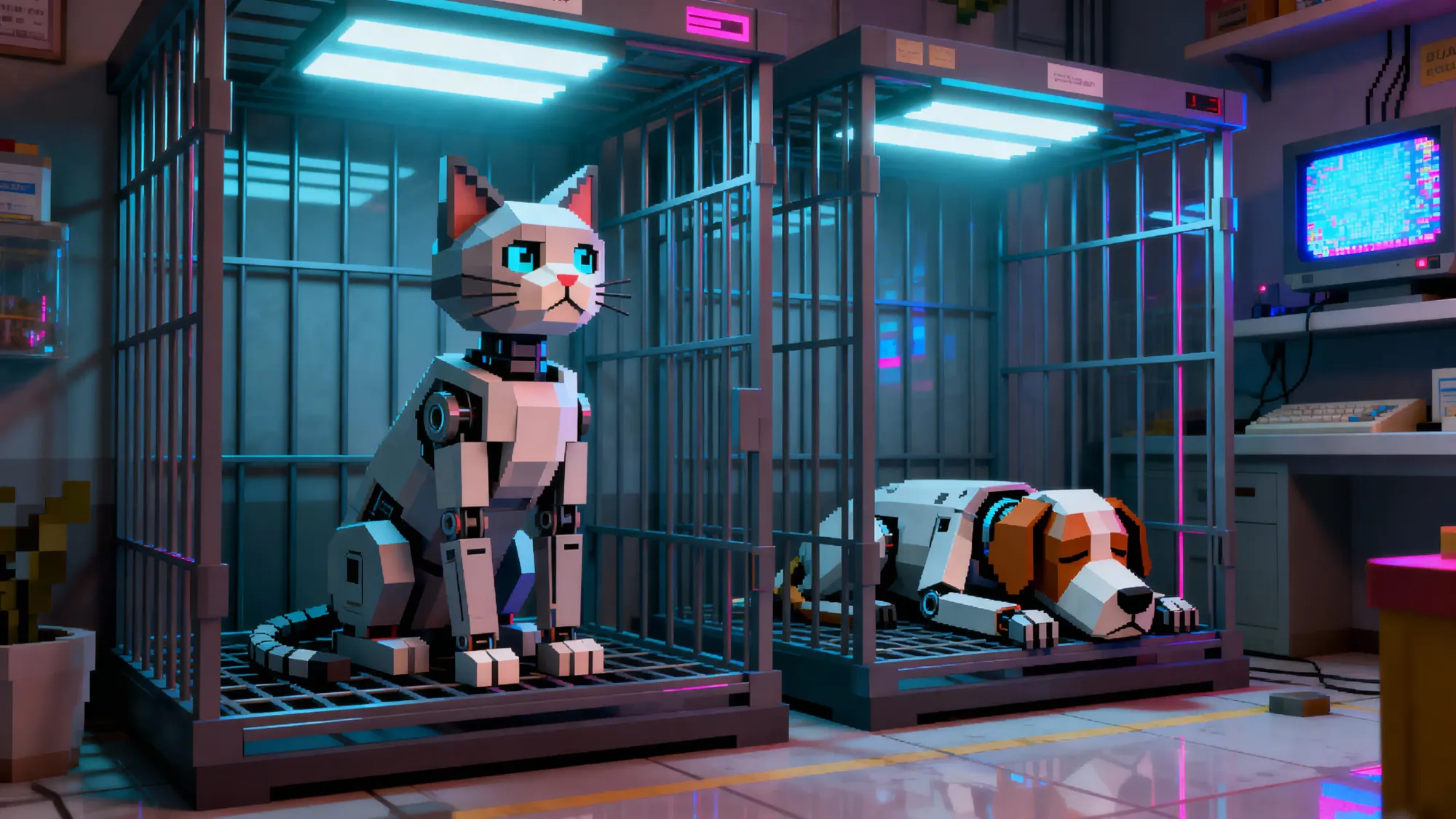
From Sony’s metallic clanker Aibo, the robocanine that will always be significantly less cool than Blitz 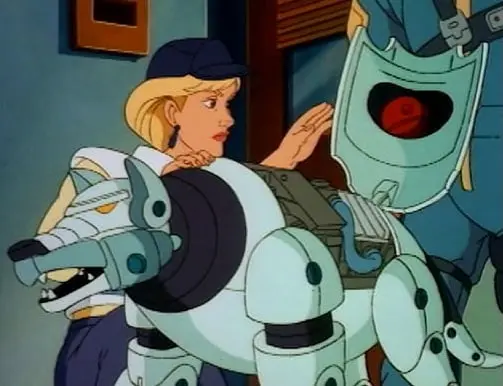 The robotic dog in the 80s C.O.P.S. animated cartoon. , to the humble Chia Pet - a glorified house plant, nothing screams 21st-century millennial ennui more than our love affair with artificial pets.
In an age where we’re just as likely to build a relationship with an LLM 1 as with our own neighbors, these inanimate critters can elicit a surprisingly strong emotional connection. So prepare yourself to dive into the rab-BOT  hole of their storied history.
The Pet Rock
In the 1970s, an advertising executive by the name of Gary Dahl conceived of the idea of the ultimate low-maintenance pet following a drinking session with his friends who complained about their pets. Originally intended as a gag, the pet rock, which for obvious reasons cost practically nothing to produce, proceeded to make Gary Dahl a millionaire.

It even came with a 32-page instruction manual that was chock-full (or should I say ROCKFUL hur hur hur) of word play and silly puns. For example, it was considered trivial to train your rock to sit or stay, nearly impossible to get it to shake hands, and only with assistance from the owner could it attack.
Before you begin to question the sanity of someone who would willingly pay good money to buy a single rock, this is also the same consumer public who would later go on to physically visit a fake hospital in the United States called Babyland General Hospital in order to “adopt” soft-bodied cloth dolls  What. The. Absolute. Fuck. with hard plastic heads.
PSA
If you are unable to continue caring for your pet rock, please don’t release them into the wild. That’s how we end up with guys like this.

The Pet rock, for the discerning buyer who can’t even handle the responsibility of owning a cactus.
Cha Cha Cha Chia!
The Chia Pet was first released in 1977. Physically speaking, it was basically what you’d get if you combined a piece of sod with a terracotta figurine. The word “chia” actually refers to the plant itself whose seeds are moistened and then troweled on to the figure. Roughly seven to ten days later, the seeds will germinate and you’ll be left with a zoomorphic house plant. And to top it off, it excretes oxygen instead of fecal matter.
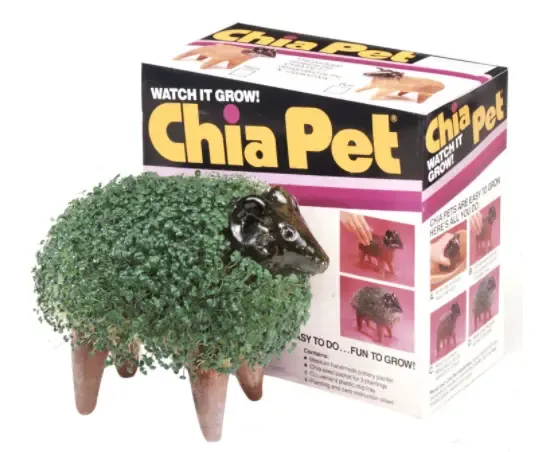
The very first version of the Chia Pet was a wooly ram, but later releases included a veritable farmyard of animals, from the domestic cats and dogs to the somewhat less logical dinosaur (but we can just pretend that they represented the evolutionary link between dinosaurs and birds yeah that checks out). It would also have made a great commercial tie-in to the Tangled movie with a Rapunzel version.
The company which produces Chia are still in business and even offer versions in the likenesses of famous people including Willie Nelson and Weird Al. Sadly they’re missing the Joker (I checked).

Tamagotchi
The Tamagotchi which is a Japanese portmanteau (たまごっち) from the words for “Egg” and “Watch” (how this wasn’t called Mr. Egg n’ Watch…), was a roughly stop-watch sized electronic toy where players would take care of a virtual pet that would hatch from an egg.
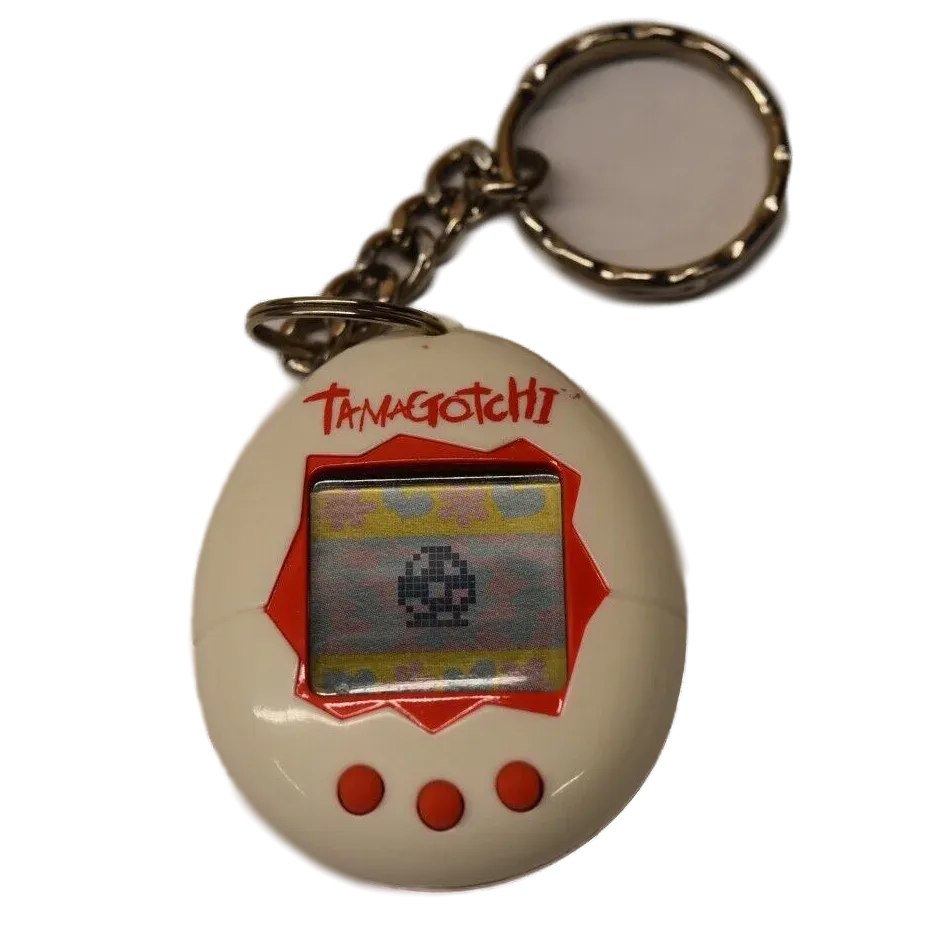
In some ways, the Tamagotchi was more work than owning a real pet, requiring constant attention from its owner and needing to be fed and cleaned at regular intervals to prevent it from getting sick.
In the earliest incarnations of this toy, your tamagotchi could die in as little as 6 hours without proper care and attention. This meant that, unless you had a brother or sister who could take care of your tamagotchi while you were away, a child’s fragile emotional state was kept perpetually hostage by the distinct possibility that your cherished companion could die at any time. A teacher punitively confiscating your Tamagotchi until the end of the school day could spell the difference between life and death for the pitiable creature.
All tamagotchis came with an internal clock so that the Tamagotchi could determine when it was supposed to go to sleep.
INSIGHT
An interesting addition to the Tamagotchi would have been a photovoltaic light sensor to sense the ambient light in the room though this would also cause the Tamagotchi to fall asleep whenever it was shoved into your pocket.
Depressingly, there is probably an entire mountain’s worth of forgotten tamagotchis buried in the same landfill that has old discarded pagers, pogs, and beanie babies.
Me Scared
Looking like a cross between Mr. Owl and a dry gremlin, the animatronic Furby came out in 1998 and was developed jointly by Caleb Chung and Dave Hampton.
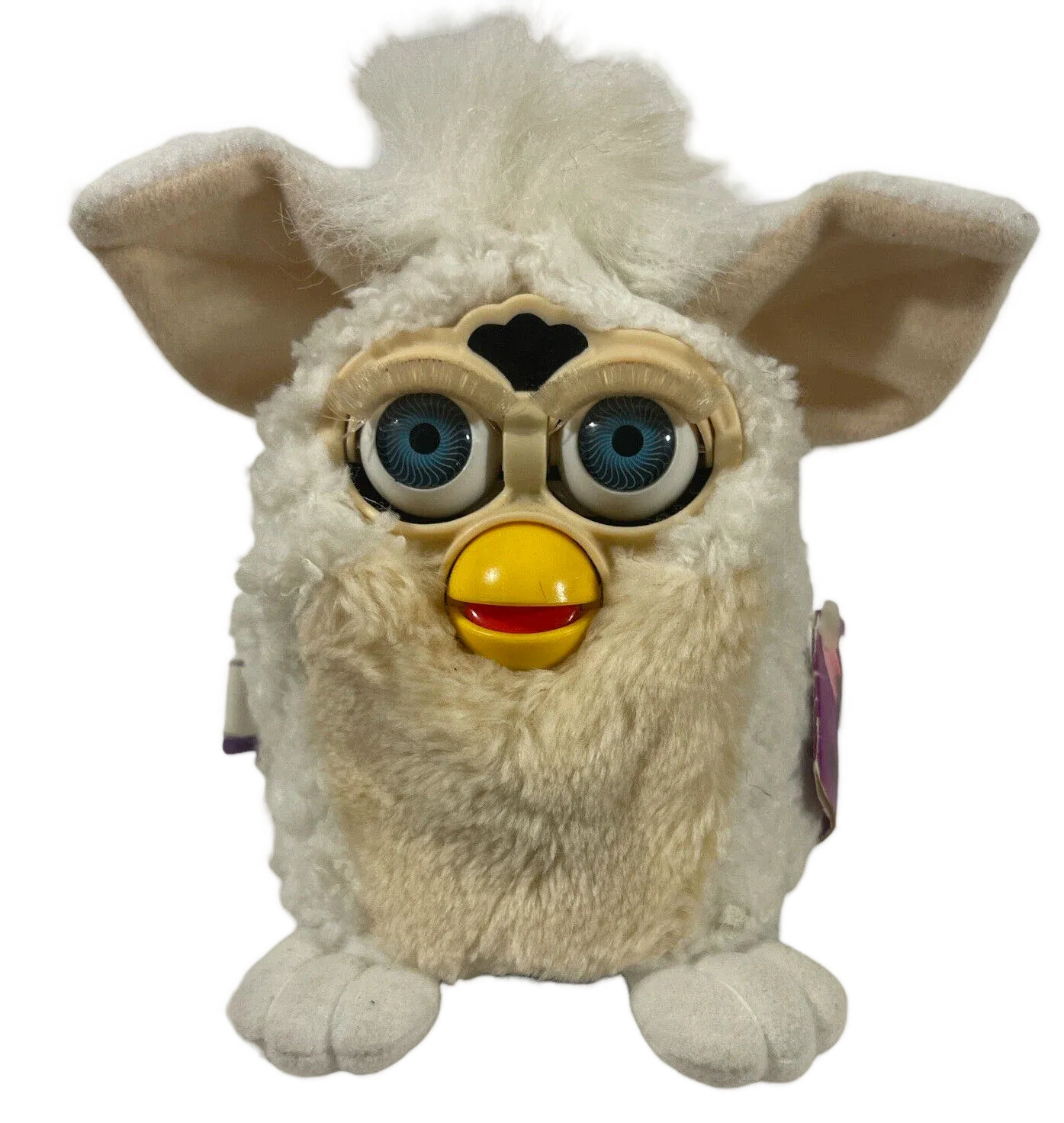
A combination of motors and cams allowed it to independently wiggle its ears, raise and lower its eyelids, and open and close its mouth which could articulate a pre-programmed library of 200 words making it more articulate than the vast majority of monosyllabic Americans  .
.
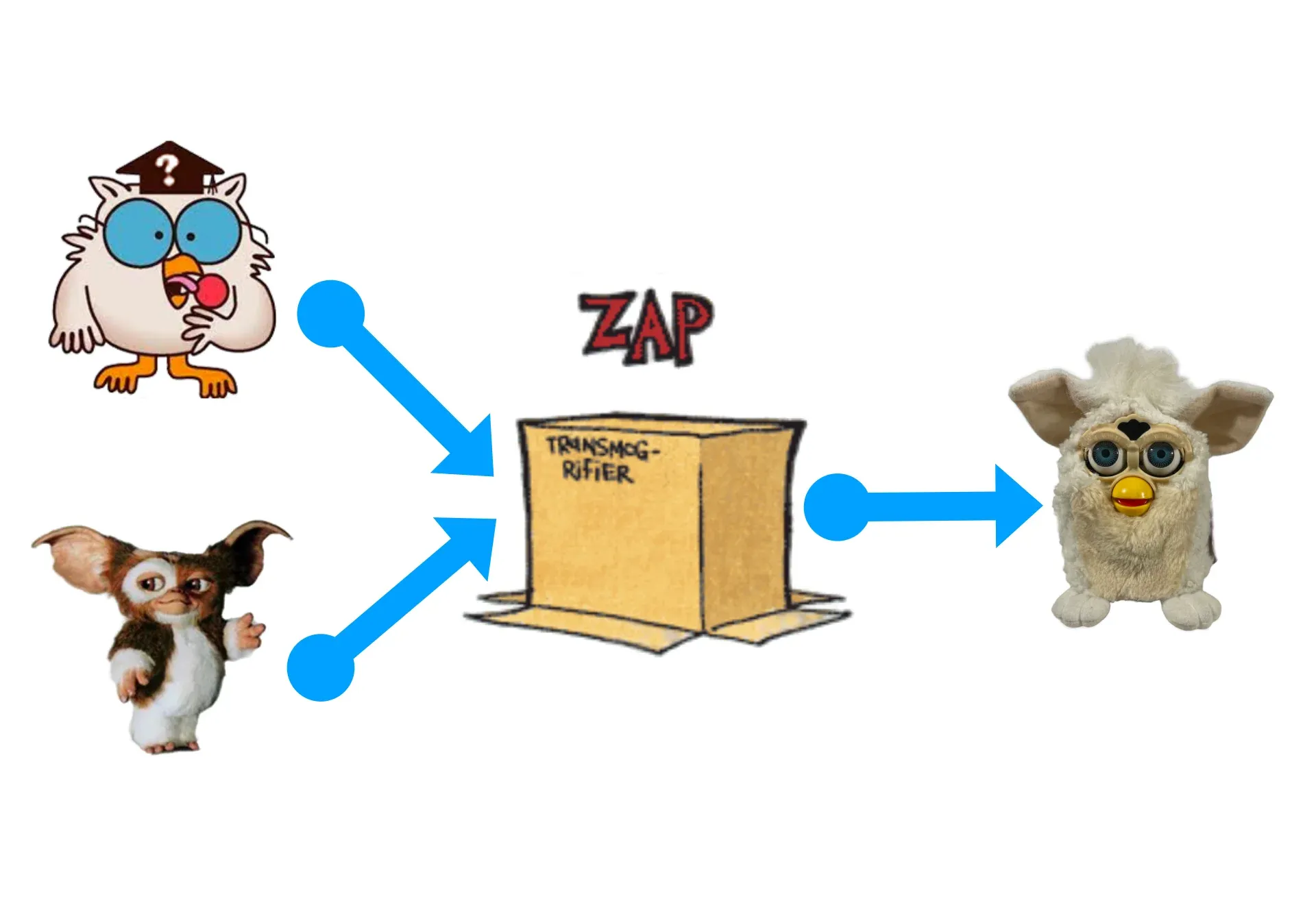
Over time, its native language of Furbish would be gradually replaced with an equivalent bank of English phrases to give the impression that the Furby was learning. This inadvertently led to several intelligence agencies banning the furby from their premises on the mistaken belief that the Furby could actually function as a sophisticated recording device.
Since half of the appeal of the Furby is its potential to “learn”, all furbies came equipped with the digital equivalent of a mind wipe. (Just like that poor R2 unit)
Every aspect of the Furby was designed to give it the impression of being alive and appealing to the owner’s emotional side. If a Furby was held upside down for a certain length of time, it would even elicit cries of “me scared”. For a deep dive into the emotional responses that can be elicited by the furby, see this excellent podcast by RadioLab.
One thing to note is that the motors and gears in the first versions of the Furby were LOUD, as in Bubo 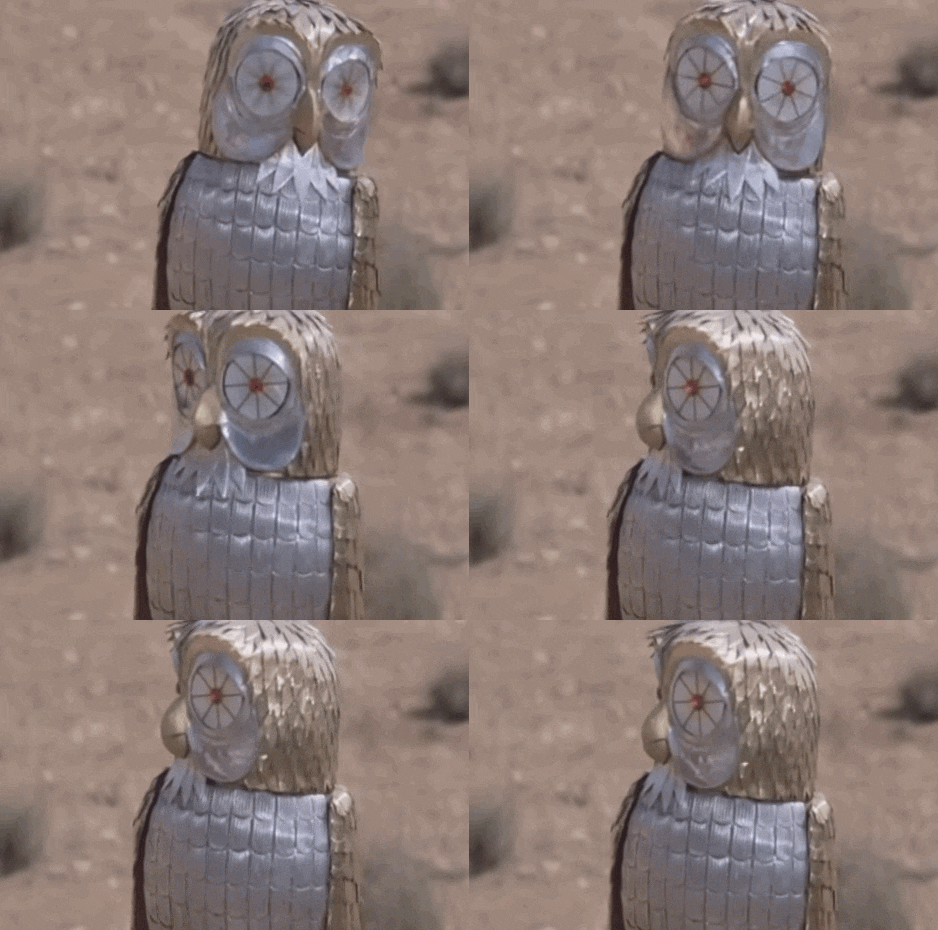 from the Clash of Titans loud. As technology improved, later editions started to sound more like animals and less like clockwork automatons.
Robo-Puppy
The quintessential robot pet was the mechanical dog, the Aibo, released by Sony in 1999. With the ability to recognize commands in different languages, Spanish, English, Japanese and binary (just kidding about that last one), in many ways the Aibo was more intelligent than a real dog  Apologies to Mr. Peabody .
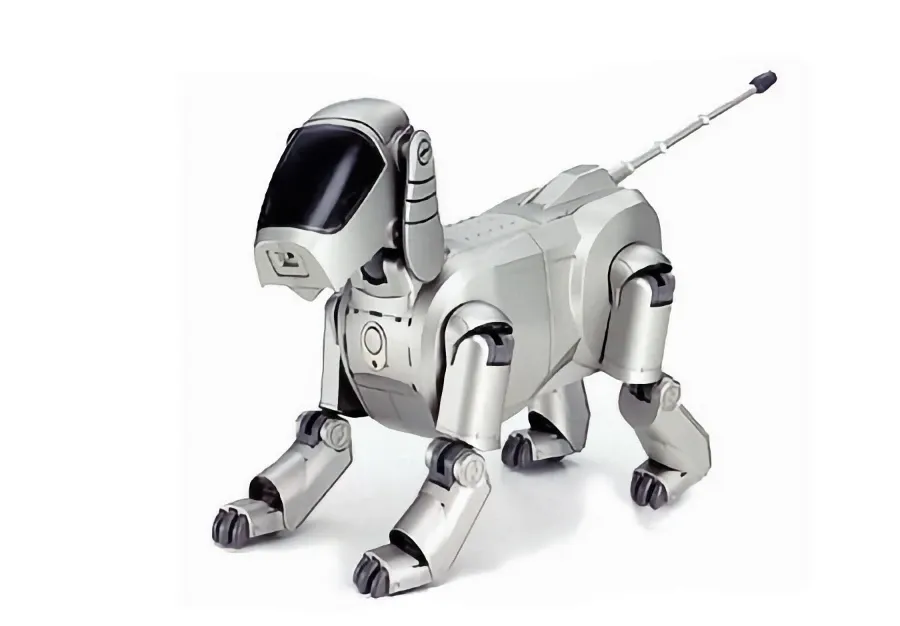
The first generation of the Aibo was loosely physically based on a beagle except for the ears, which appear to have been rather unceremoniously bolted to the sides of its head. By tracking movement using a built-in CCD camera, it can even play fetch with its owner. The emotional state of the Aibo which could range from happiness to anger was displayed through a set of LEDS mounted on the head - I cannot overstate just how indistinguishable the Aibo was from a real dog.
The multiple servos in its legs gave it the ability to walk around its environment, but conversely, also allowed it to do some disturbingly un-dog like things, many of which would have given Nadia Comaneci 2 a run for her money.
Inside the mind of a vintage Sony AIBO robot by Janus Cycle
A piece of software aptly called “Life” using the now defunct “Memory stick” technology could be inserted into your Aibo to allow it to go through the various stages in a typical canine’s life, from puppy to full-blown adult. Later versions came with this functionality out of the box.
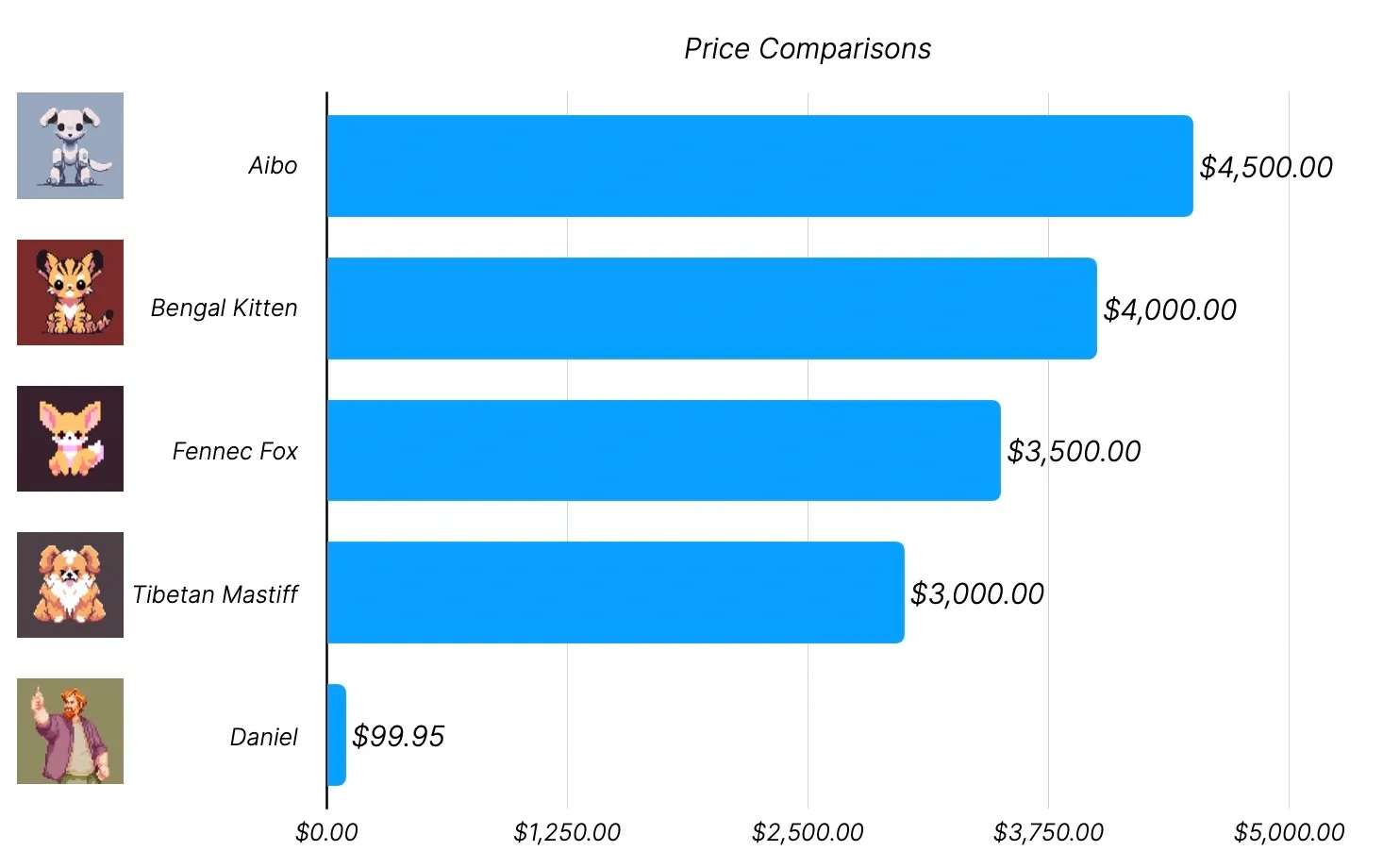
Later on, Sony released an SDK allowing owners to create anything from custom dances for the Aibo, all the way down to entirely new behavioral modules. It was without a doubt one of the most sophisticated virtual pets ever created and, not coincidentally, also the most expensive on our list, having retailed for nearly 2500 dollars in 1999 (approximately $4500 when adjusted for 2023).
Here’s what your money could have also gotten you:
If you have that metal fever and feel that Sony doesn’t collect enough of your user data through your smart TV, Playstation, or phone, you can still buy an Aibo today for the low low price of $3200.