

Recently, I was reading a story about Brian Johnson (the millionaire tech entrepreneur turned longevity expert) where he was interviewed by Wired on the nature of immortality. One of the first questions asked was whether or not he was going to die at some point in the future to which he responded “no” and proceeded to clarify that he has a “Bryan AI” that has digested everything he has ever said.
While this is an absurd answer, it got me thinking about the mind and the idea of irreducible complexity - specifically around the sorites paradox: at what point does the removal of a single grain of sand turn a heap into a non-heap? The same question might be asked of consciousness. How many neurons can be removed before the “self” ceases to exist? How many licks does it take to get to the center of consciousness?
This paradox becomes significantly more important when applied to hypothetical neurotechnological augmentation. This trope is often expressed as a form of “digitization of one’s consciousness”. But of course, as we all know from watching too many episodes of pattern buffers gone wild in various episodes of Star Trek, copying and transferring are not equivalent.
Supposing we did want to fully digitize a human WITHOUT merely making a digital xerox? Let us imagine a nano-neuron, a synthetic neuron, injected into the patient’s skull and engineered to observe and study a single biological neuron. It watches, listens, and gradually learns to mimic that neuron’s output by reacting to the same inputs. Over time, it becomes nearly indistinguishable in function. If its output matches the original neuron’s with some acceptable threshold (the importance of this variable cannot be overstated) then for all intents and purposes, it can function as an equivalent prosthetic neuron.
Eventually, once a nano-neuron has been A/B tested against the real one and developed a robust internal model - it can assume the responsibilities of the original, and the biological neuron can be “decommissioned”. Slowly, neuron by neuron, the system becomes synthetic.
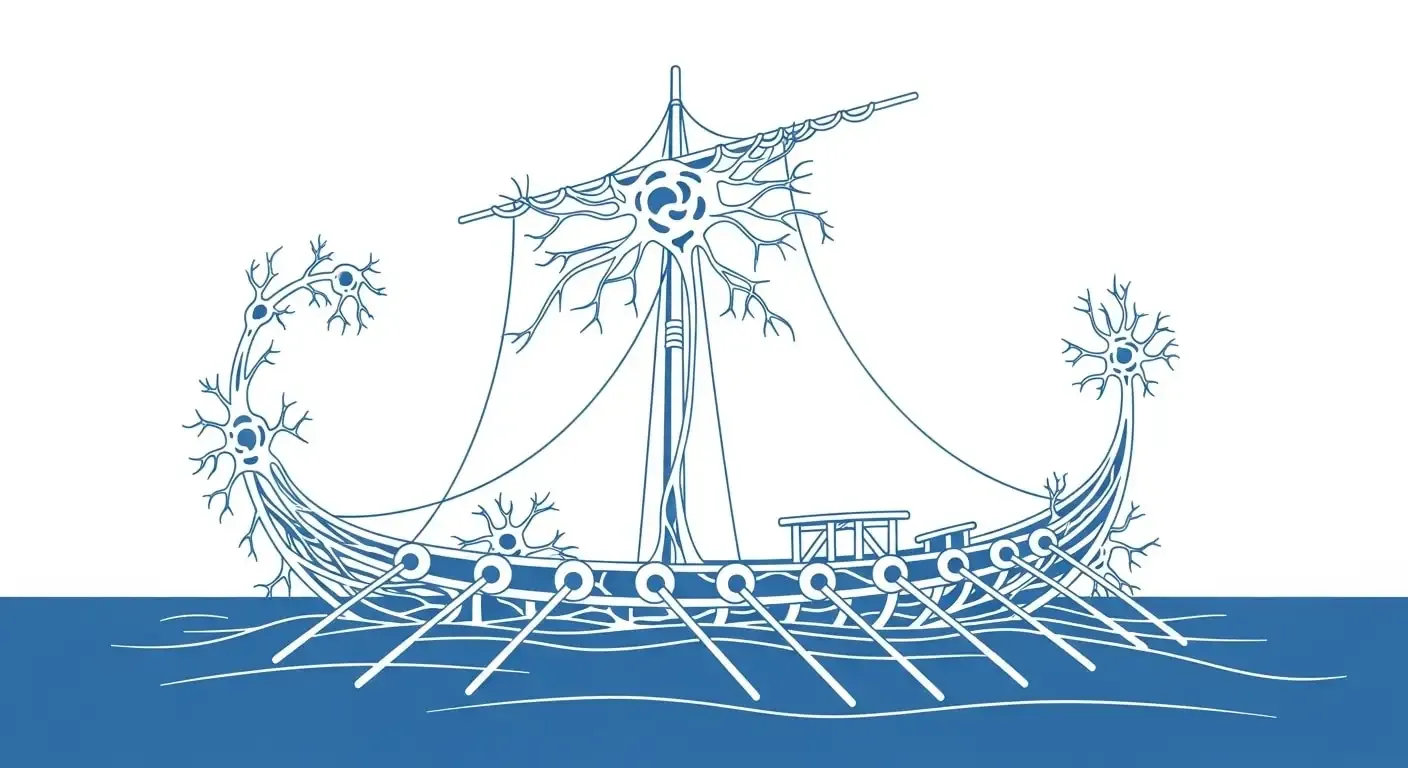
If this process is carried out in a deliberately gradual manner, it begins to resemble a neurological version of the Ship of Theseus. Given a sufficient span of time, one could conceivably replace all the neurons in the brain with nano-neurons. We’re already at the stage where modern day medicine has managed to provide prosthetics or replacements for many other bodily systems. The brain remains the final frontier - the critical component in creating a fully artifical replacement for the human body.
But is the “self” preserved through this transition?
The continuity of self becomes a critical philosophical and technical question. For such a process to be viable, this replacement must happen over an extended period. This slow transformation is essential to maintaining the illusion or reality of uninterrupted consciousness.
I call this concept the Chips of Theseus.

We already know that this idea has at least some precedent in nature. Neurons die all the time with estimates between 75-100k per day 1 yet the continuity of consciousness is preserved. This implies a significant level of built-in redundancy within the brain 2 - a safety net that might allow such a transition to occur without disrupting identity or awareness.
If humanity is ever to unlock the secrets of immortality - whether by halting aging via telomere manipulation, discovering the fountain of youth, or being bitten by a member of the Nosferatu, the chips of theseus might be the most plausible path forward. And I say this with all the outrageous confidence that somebody with a complete and utter lack of any academic experience in the field of medicine or biology can muster SO IT MUST BE TRUE.
Footnotes
-
Life and death of neurons in the aging brain - Morrison, J. H., & Hof, P. R. (1997) ↩
-
Neural circuit function redundancy in brain disorders - Beatriz E.P. Mizusaki, Cian O’Donnell (2021) ↩