

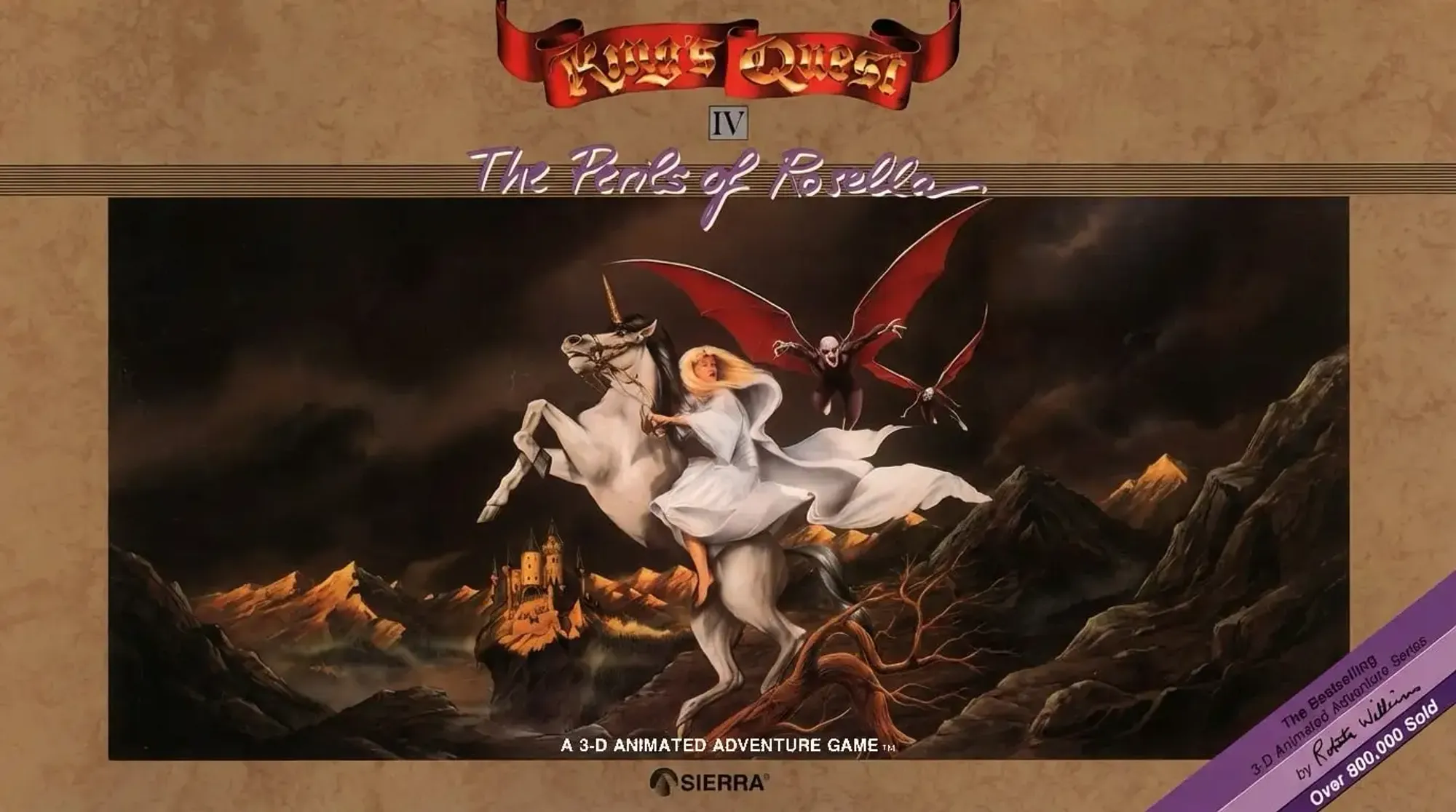
King’s Quest IV: The Perils of Rosella is a 1988 adventure game developed by Sierra On-Line and designed by Roberta Williams already famous for her work on King’s Quest I-III (who would have guessed!). Former adventurer King Graham is on his deathbed and his daughter Rosella seeks a magical fruit said to restore life. The fairy Genesta offers guidance but is ALSO dying herself after the dastardly evil fairy Lolotte steals her medallion. Rosella must recover the medallion to save Genesta and find the fruit before her father’s time runs out.
At the time it was highly impressive featuring one of the first early female protagonists in computer gaming, adding a day-night cycle, and better graphics. But this is not the focus of this blog post, you can read it on Wikipedia if you’re so inclined.
Instead, I’m here to tell you that as a child I absolutely loved this game but as an amateur game designer, I ABSOLUTELY HATE IT. From the random delays and waiting puzzles to the unwinnable states and hidden objects, the design is early-Nintendo levels of cryptic codswallop 1. These are the puzzle-game equivalents of Bilbo’s ridiculously contrived riddle, “What have I got in my pocket?”, which in any reasonable court of law would be sufficient legal justification for Smeagol to tear the hobbit’s head off.
Oh, and did I mention you’re on the clock 2? Nothing says fun like an invisible shot clock.
Like many early graphic adventure games, it still featured an accompanying text parser where you could type commands such as get sword, get key, and later get bent.
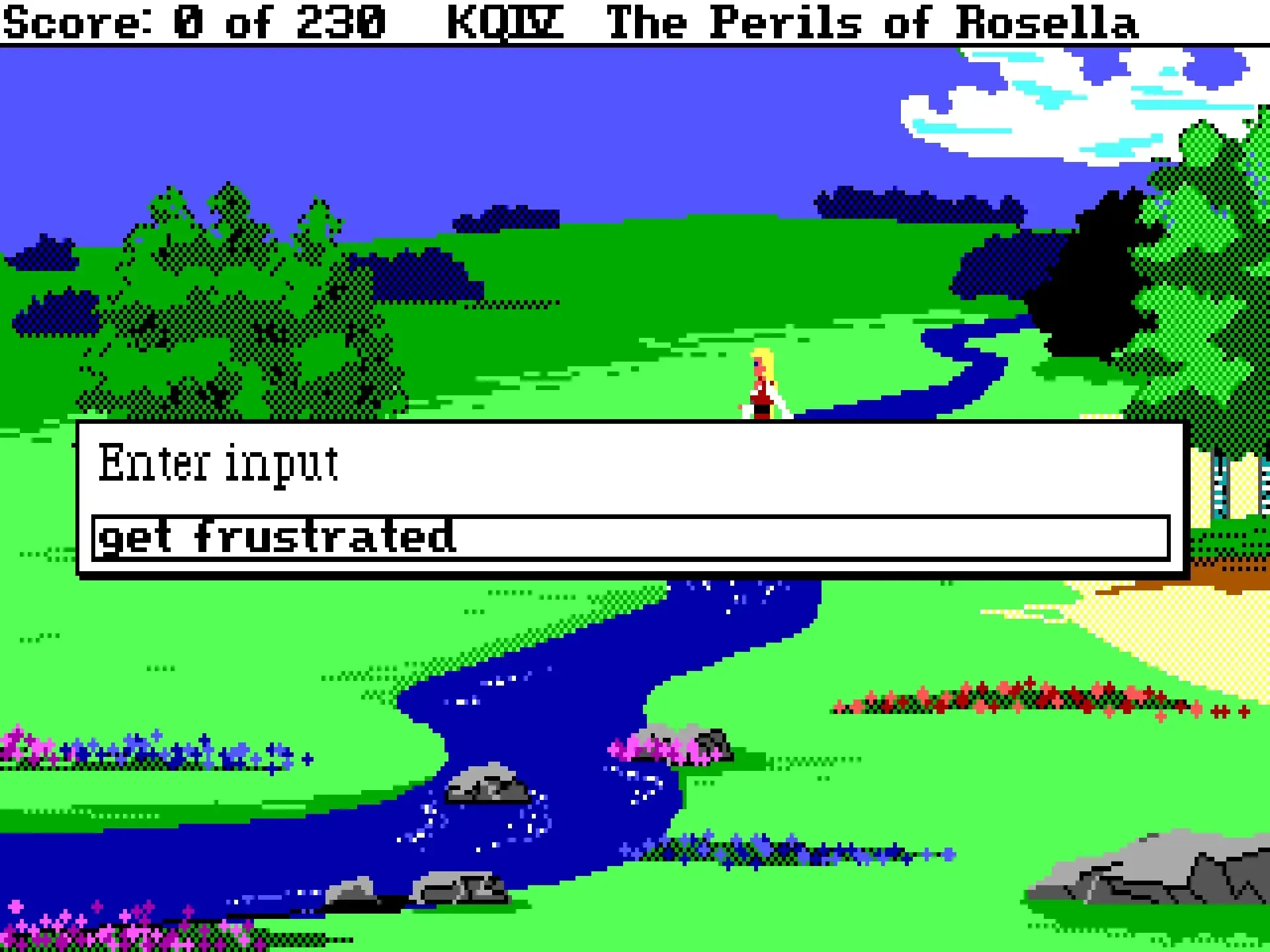
Maybe they should have had a built in keyword to “phone a friend” which would use your U.S. Robotics Hayes 14.4 kbps modem to connect you to a pay-per-minute 1-900 hint line featuring the slowest talking operators that Ken and Roberta Williams could hire.
ATTENTION
From here on out, this review contains some minor spoilers so if you’re still catching up on your gaming backlog from nearly four decades ago, caveat lector.
The Island
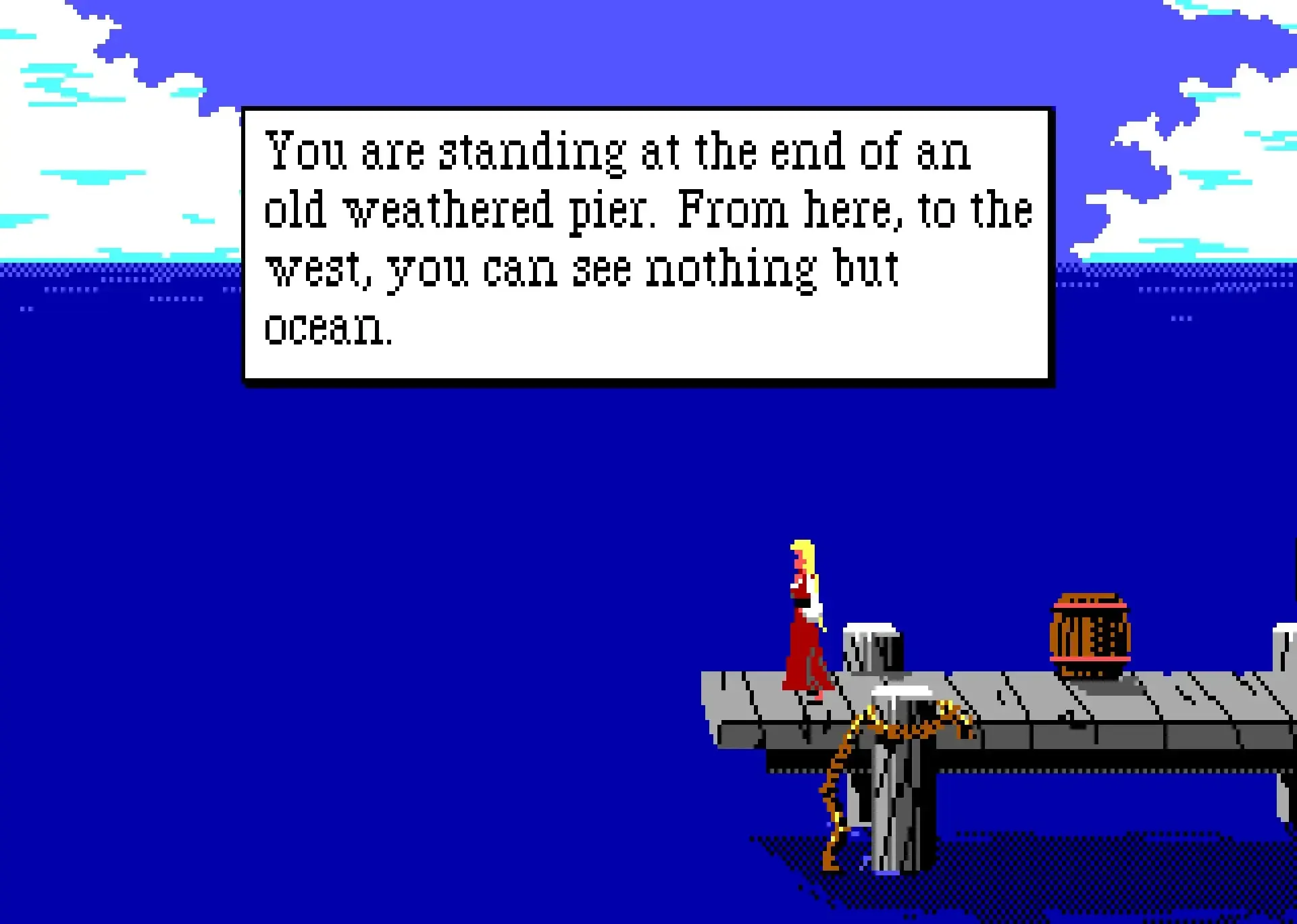
Near the beginning of the game, there’s an island out in the ocean. It’s a few screens of swimming to the west from the pier. Can we talk about swimming? Swimming in an adventure game is like swimming for a Belmont - it’s almost never a good idea. On top of that, the game throws sharks, a whale, and drowning at you, all of which serve as strong signals that you’re not supposed to go that way.
Someone might argue, “Well, the fairy flies off in that direction, so that’s your clue.” But in practice, that just reads as a standard cutscene transition. Most players will assume the fairy is simply leaving the scene, not that they’re meant to eventually physically follow it across multiple screens of open water to some unseen island they don’t even know exists.
How would you fix it?
If you wanted to do this properly, you could place an abandoned lighthouse on the coast. When the player climbs it, they find a broken telescope. They replace the lens by stealing a monocle from an old gnome, then look through it toward the ocean and spot an island far off in the distance. That clearly signals, “There is something out in that direction you’re supposed to reach,” and it gives you an in-world justification to go swimming or start looking for a way across.
The White Whale
During your fun little transatlantic voyage, you might notice a whale in the distance. If the whale happens to swallow you at this point - congratulations, you’re dead. Besides an easter egg in the form of some messages from the developers, there’s nothing inside the whale that you are supposed to retrieve.
That teaches you: “The whale is bad. Avoid the whale.”
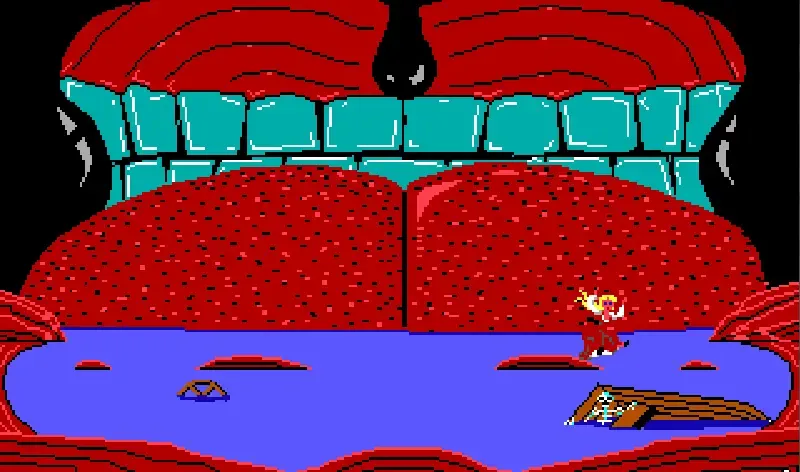
However, if you managed to reach the island, you can pick up a peacock feather. It is at this point that the game expects you to get deliberately swallowed again so you can use the feather to tickle the whale’s uvula and force it to spit you back out.
You’re probably thinking (like any sane person), “What’s the point of having a whale swallow you only for it to bulimically vomit you back up?” Especially since as we’ve already discussed, there’s nothing to do or get inside the whale in the first place. Props to you - you’re thinking like a sane person. You’ll need to stop doing that if you want to get anywhere in this game.
How would you fix it?
If there was a quest item you could pick up inside, that would hint, “Hey, there’s something in here worth getting.” You might then logically connect the feather with the whale and intentionally get swallowed again to use it to retrieve the item and then escape.
Now onto one of the most obnoxious parts of the game. In order to reach the uvula, you have to climb up the whale’s tongue. Make one wrong move and down you go. Figuring out exactly where to click is like playing a game of invisible scavenger hunt.
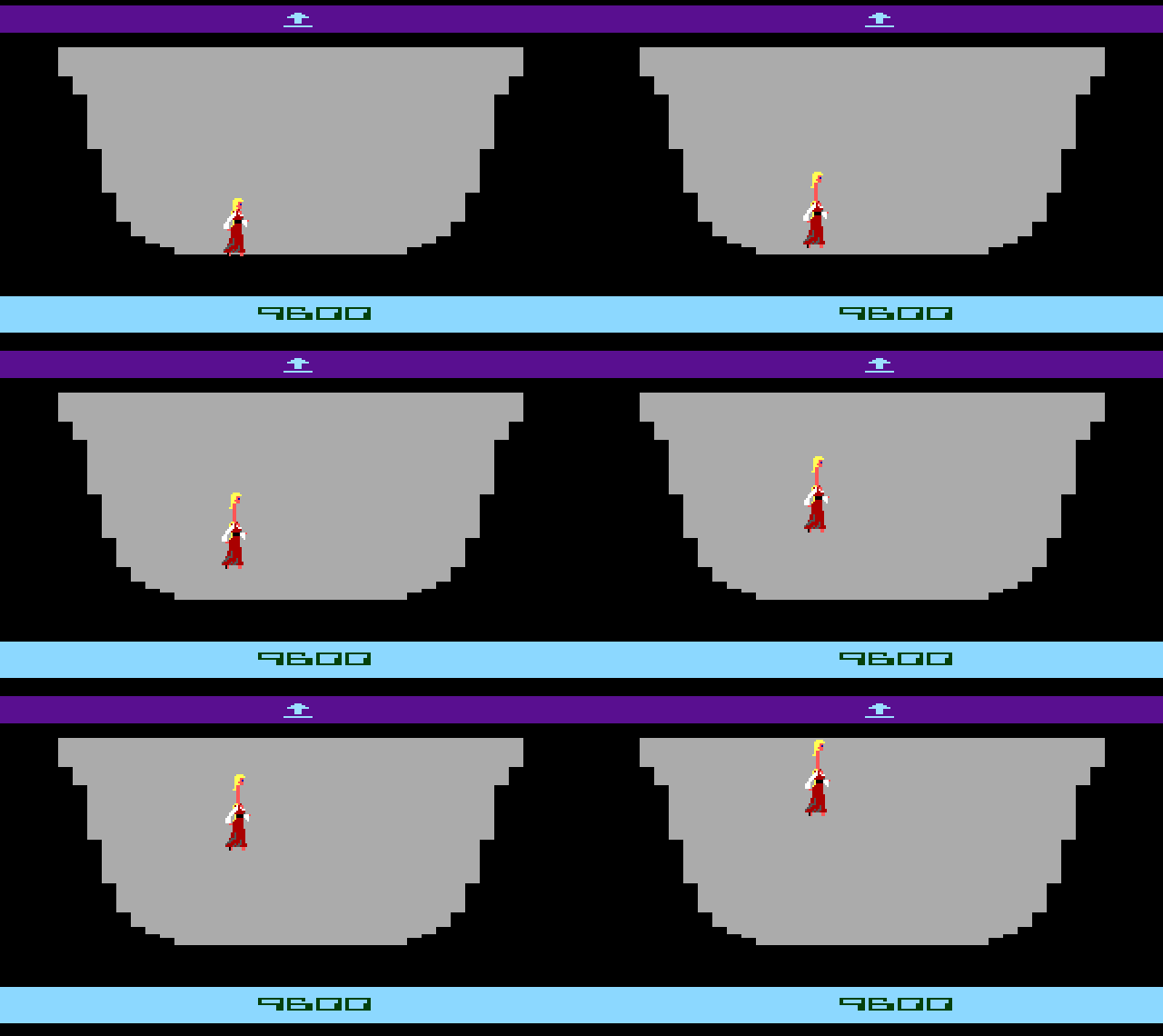
And the thing is, after falling for about the 50th time, a player might conclude that this is basically the game’s way of saying, “Hey, that’s not the solution to the puzzle!” But sigh, you actually are supposed to do this.
How would you fix it?
If certain parts of the tongue were clearly different like a rougher texture, a distinct color, raspier texture, or if you had to climb along the molars instead of the incisors then you’d at least have a visual indicator of what’s climbable. Alternatively, the water level inside the whale might continue to rise as it swallows more of the ocean. See the small wrecked wooden boat in the bottom right? Rosella could climb onto it and wait for the rising water to carry her close enough to tickle the uvula.
After you give the whale a friendly tickle, it spits you back out into the ocean. This time, however, you’ll notice the silhouette of another island off to the north. Swim toward it, and you’ll arrive at the next problematic element of the game.
The Golden Bridle
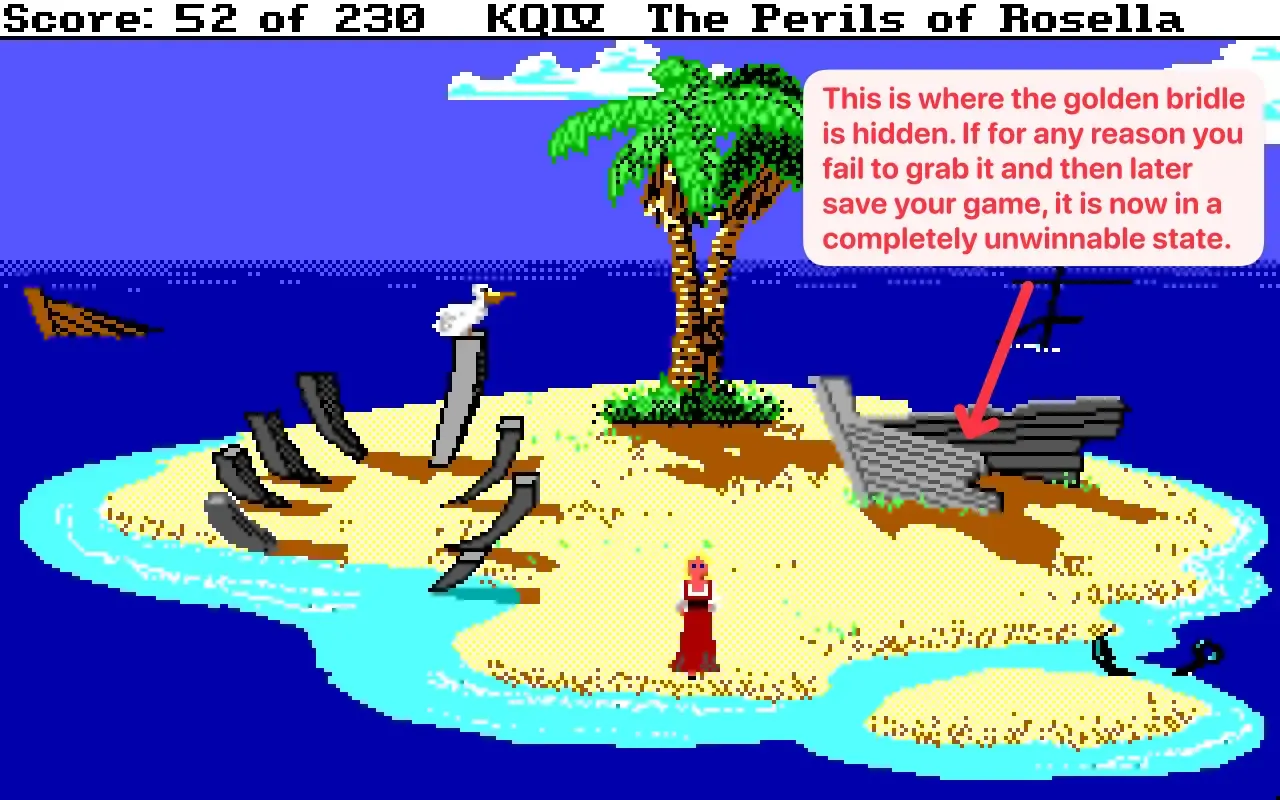
At the beginning of the game, most players will have noticed a unicorn that randomly appears (even more RNG) on various screens. You can try to ride it or even shoot a couple of Cupid’s arrows at it, but it’s no use, it’ll just run away. That’s the whole point of this little spit of an island. The crucial item is here, once again hidden with almost no visual indication that it even exists.
In the game’s defense, if you look around, the text will mention a glint of something. But to actually pick it up, you have to be standing exactly where the arrow in the following picture indicates.
How would you fix it?
To be honest, I would completely cut this island from the game, and place the golden bridle inside the whale. Then I’d place the pelican (which is also important in the game) somewhere on the coast of Tamir.
This entire sequence from ocean -> island -> feather -> whale -> girdle is just a perfect storm of really unfortunate game design. It would make for a great case study of how not to design a collection of interconnected puzzles.
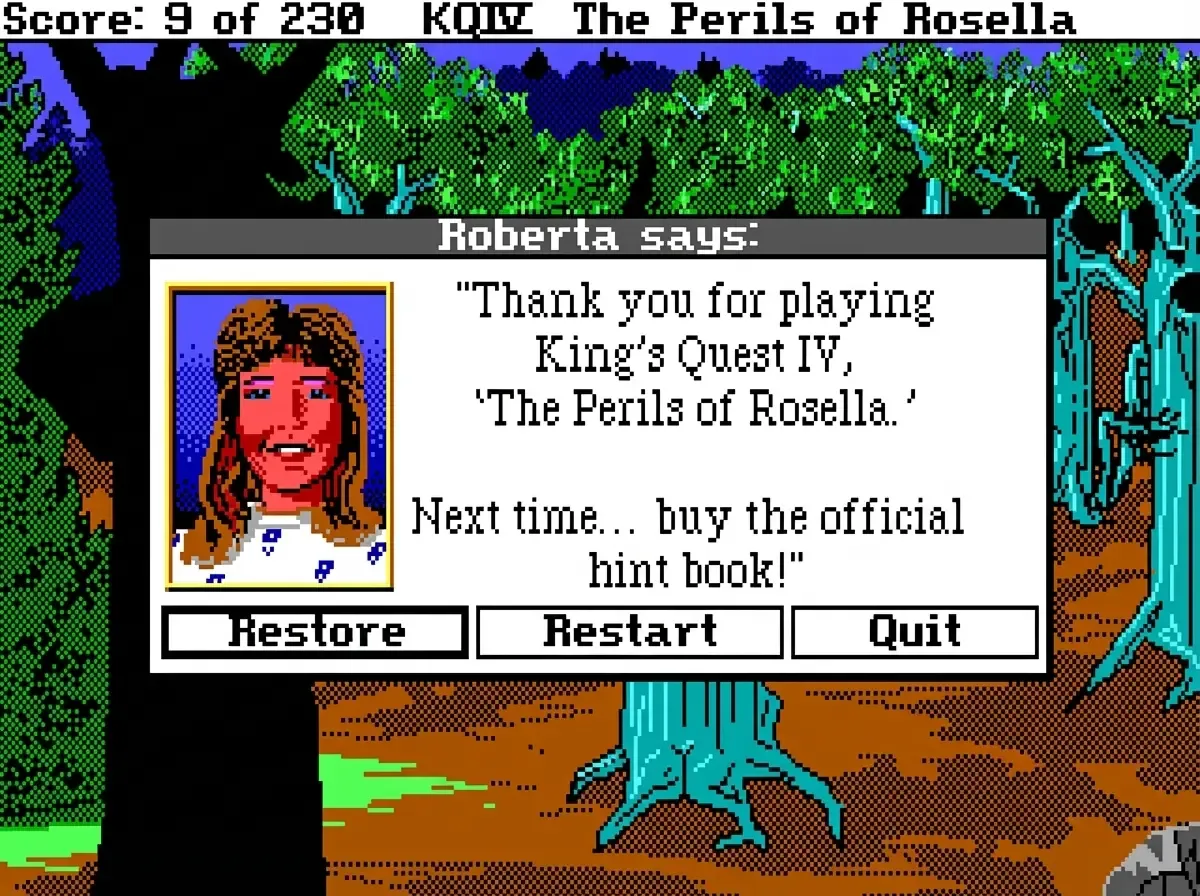
I’ve jokingly suggested that the primary purpose of King’s Quest IV was to sell hint books. In fact, the guidebook came out years before the existence of the game, but it just wasn’t selling well 3.
Footnotes
-
Are you telling me you didn’t know that kneeling with a red crystal in front of a cliff summons an uber tornado for 1st class transportation? ↩
-
Rosella only has 24 hours of in-game time to complete her quest - this equates to six actual hours. ↩
-
All kidding aside, I still adore this game and have nothing but respect and admiration for Roberta Williams and the entire Sierra Online team! ↩