

I’ve had a lot of fun taking some of my older songs and using AI to create covers of them. This piece, Screwdriver Sonata in D Minor, is a composition I wrote for piano over a decade ago.
What excites me about AI in music isn’t necessarily its ability to spawn an unholy zerg swarm of new songs, but rather how it enables composers like myself to experiment with different orchestrations instantly. Being able to hear your composition performed with alternate instrumentation-even if somewhat mechanical-opens up exciting possibilities for experimentation.
A Direct Comparison
Let me show you exactly what I mean. Here is the first four bars of the original piano composition:
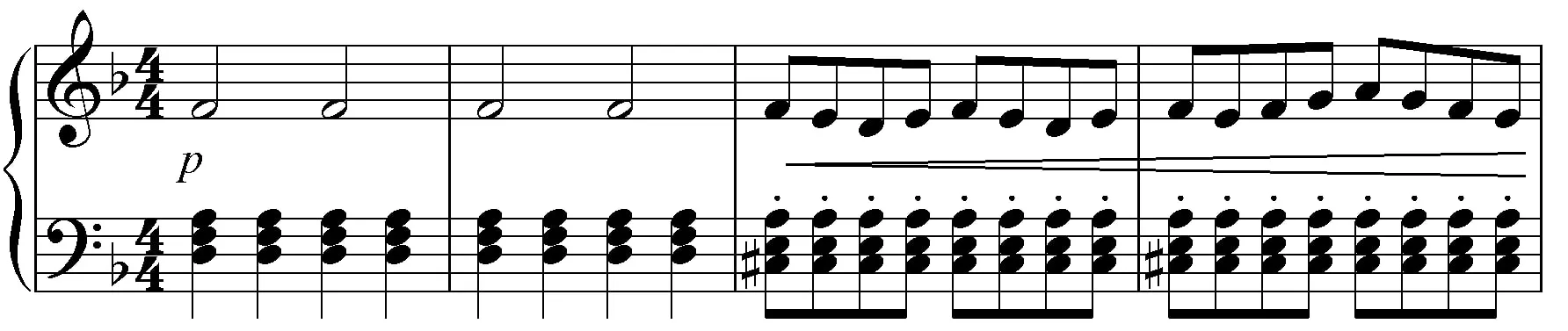
First let’s listen to the original passage on piano, then the exact same passage arranged for a chamber orchestra using AI.
Clip from Original Piano Composition
Clip from the Orchestral Arrangement
Notice how the melodic structure remains intact while the AI explores how different instruments can interpret the various voices and harmonies.
Full Performances
Here are the complete performances of both versions for those interested in hearing the full arrangement.
Piano Performance by Lucy Zhang
Orchestral Arrangement
Sheet Music
The complete sheet music for the piano version is available below. Click on the images to view them in fullscreen, or use the navigation arrows to browse through the pages.
Conclusion
We are probably naively hoping that AI will be used as a collaborative tool for musicians to explore new sonic possibilities. However we recognize that the predominant use case by a mainstream audience will likely be used to generate the entire song from the chord progression, the lyrics, the melody, the structure, all the way down to the performance - and then hurled into the world in a deluge of pure AI generated noise.